Caremaxxing in an Era of Fear
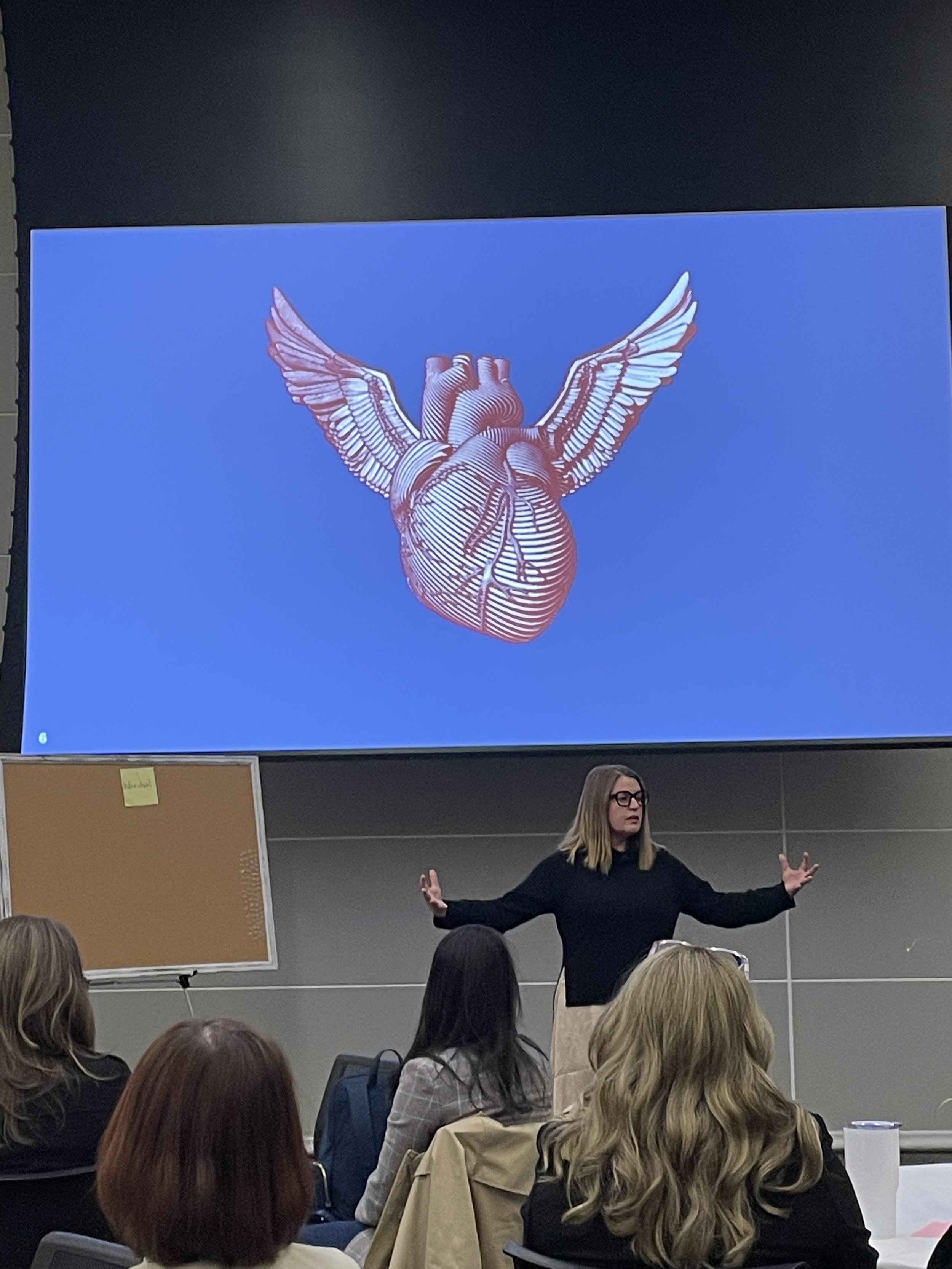
Image of me facilitating a workshop and talking about the capacity of our hearts, the muscular structure to empathy.
Hello LoveYou2 Community!
I hope your summer is full of tiny joys and slow moments. I am looking forward to my nieces visiting and enjoying long weekend hikes.
I don’t consider myself a trend follower, though it’s not hard to track what is trending these days with a quick scroll—Doomer or otherwise—on the internet. Recently, I’ve been struck by the hyper-trend to optimize. It isn’t actually new; we’ve long been obsessed with scale and perfecting ourselves. But lately, there is an absurdity to how it is named. There is looksmaxxing, proteinmaxxing, sleepmaxxing, fibermaxxing, girlbossmaxxing.
Well, that got me thinking. I wonder what would need to be true so that we could collectively be caremaxxing?
What would it look like to caremax—not in service of just ourselves, but to imagine the relational architecture needed to sustain us? I think caremaxxing is an antidote to the silos and divides of these times. It is a soothing reset to imagine what would need to be true for us to care so much in the face of fear.
The news cycles train us to scan for threats (increasingly pointing at each other), feeding on our evolutionary instincts in favor of clicks. And no doubt there are real threats—from gun violence to depleting public infrastructure, and the all-out attack on trans people and immigrants. Fear as a response is real, and yet, so is care, so is tenderness.
Increasingly, I am convinced that care and tenderness are among the most serious, most rigorous responses we can have to these times. Not as a soft-skill add-on or something we do after the fact, but as a core practice of survival, resistance, and world-building.
I don’t want to caremax to optimize because I want another metric or to do list. But I do ask myself and pose to you: what would it look like to center care—to build care—in an age of fear and growing authoritarianism? What does care look like in a time of control?
Care is not innocent. It is not naive. Care can be used to justify control. But we also know that neighboring—the practice of caring for our neighbors as an act of solidarity and mutual aid—has been a formidable response to terror throughout history. In other words, care is already doing the work. Care is doing the heavy work of holding us together. The real question is: will we name it for what it is, resource it, and figure out how to protect it? We must protect both the care we experience between each other as interdependence, and the care that is part of the infrastructure we need to thrive.
As someone who wants to be in my caremaxxing era, I am choosing collective care as part of how I show up. I am committing to building the inner and outer resources that make this kind of care possible. I will choose my tenderness as a political force, not a hobby, and ask again and again: what would it take to make care durable?
This is not about perfect routines or performative self-care. I am not looking to craft another version of reality for us to perform. Instead, I am asking to explore what kinds of care we need now, and how we can make them shared and lasting. One of the quiet violences of our time is the expectation that we will care endlessly while being under-resourced and harmed. But the solution is not to stop caring. The solution is to figure out how to resource ourselves to care in the ways that matter.
The problems of our time will not be solved with caring alone. But I refuse to let fear and scarcity be the defining characteristics of the future we are creating. I am seeking ways to expand my heart and my capacity for caring that are sustainable for the long haul—so that as we build that future, it is one that is full of care.
Yours in love,
Shannon Weber